
For decades, interactive voice response has been the front door of the business phone line: press 1 for billing, press 2 for support, then wait. That model still handles large call volumes reliably, but customers now talk to voice assistants every day and increasingly expect a business line to understand them the same way. AI voice agents promise exactly that. Before replacing anything, it helps to understand what each technology actually does, where each one shines and how the two can work together.
The real question is not whether IVR or AI is better. It is which one gives each caller the fastest, clearest path to what they called about.
How Traditional IVR Works
A traditional IVR is a decision tree. The caller hears a prompt, responds by pressing a key or saying a word from a short list, and the system follows a predefined branch to the next prompt, a self-service task or a queue. Many IVRs connect to back-end systems to read a balance, confirm an appointment or take a keypad payment, and some add directed speech recognition so callers can say “billing” instead of pressing a number. Everything the IVR can do, however, has to be designed in advance. When a caller’s need does not match an option, or they phrase it in an unexpected way, the menu cannot adapt, and the usual result is a repeated prompt, a wrong turn or a transfer.

An IVR follows the script you wrote. An AI voice agent follows the conversation your caller starts.
What Makes AI Voice Agents Different
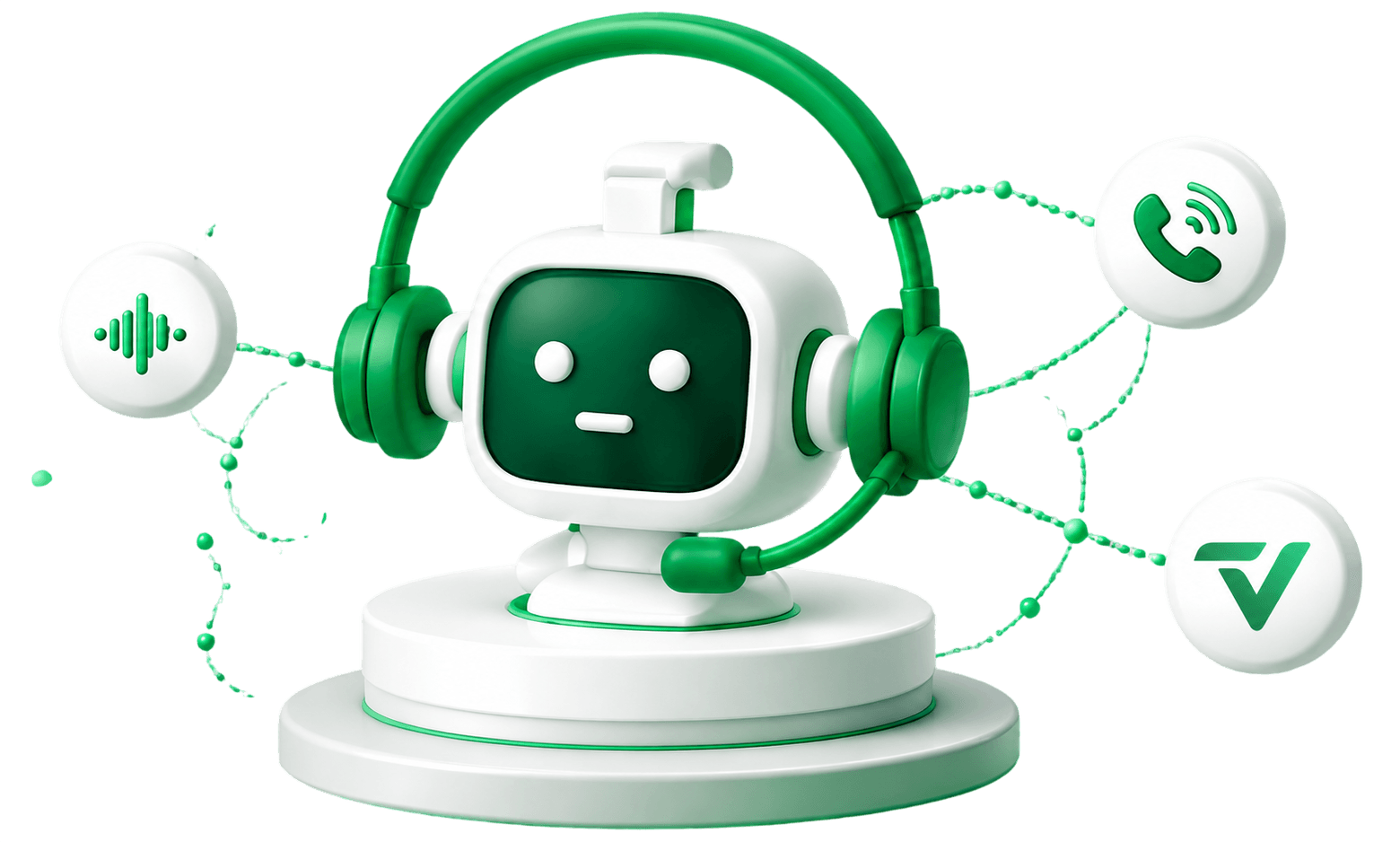
An AI voice agent replaces the menu with a conversation. Speech recognition turns the caller’s words into text, a language model works out what they want, and text-to-speech replies in a natural voice. Callers explain the problem in their own words, the agent asks follow-up questions when something is missing, and it remembers what was already said. Connected to your CRM, scheduling, order or billing tools, it can complete the task instead of only routing the call, always within guardrails you define.
These capabilities set AI voice agents apart:
Natural Language
Callers describe what they need in everyday speech instead of memorizing options.
Intent Understanding
The agent identifies the goal behind a request, however the caller phrases it.
Context Across the Call
Details shared earlier carry forward, so callers never have to repeat themselves.
Actions in Connected Systems
Look up orders, book appointments or update records directly in your tools.
Personalized Conversations
Use customer data to tailor answers to each caller’s account and history.
Smooth Human Handoff
Transfer complex or sensitive calls to a person along with a conversation summary.
Strengths and Trade-Offs
Neither approach wins on every measure. IVR is predictable: every caller hears the same approved wording, behavior is easy to test and audit, and keypad input stays dependable in noisy places. It suits short, structured tasks well. Its weakness is rigidity, because deep menus add effort, unusual requests fall through the cracks and every new option means reworking the tree. AI voice agents flip that balance. They handle varied phrasing, multi-part requests and follow-up questions, and adding a capability feels more like teaching than rebuilding. In return, they need clear guardrails, secure integrations, careful testing with real accents and background noise, and ongoing monitoring of what they say.
Choosing the Right Fit
IVR is still the right fit when options are few and stable, when callers mainly need a quick choice such as a language or department, and when exact scripted wording matters more than flexibility. It also works well for secure keypad entry of sensitive details and for simple after-hours messages. AI voice agents make sense when callers ask for many different things, when requests need some back-and-forth, or when menus have grown so large that people press zero just to escape them. They are especially useful for rescheduling appointments, answering order questions, qualifying leads and covering calls outside business hours.
How IVR and AI Voice Agents Work Together
Moving to AI does not have to be a single, risky switch. Many teams begin by placing a conversational front end ahead of their existing routing, letting callers state their reason for calling and then sending them to the right queue or self-service flow. Proven IVR flows such as authentication or payments can keep running while the agent takes on open-ended requests, and menus can shrink as the agent proves itself.
A phased migration keeps risk low and builds evidence at every stage:
- 1
Audit current flows
Review menu paths, recordings and transfer reasons to find common requests.
- 2
Pick first use cases
Start with a few frequent, low-risk intents that have clear outcomes.
- 3
Pilot alongside IVR
Send a share of calls to the agent and test with real callers first.
- 4
Keep a fallback
Leave keypad options and an easy route to a person available.
- 5
Measure and expand
Compare resolution, transfers and satisfaction, then add more intents.
The Bottom Line
IVR and AI voice agents solve the same problem in different ways. IVR brings structure and predictability to simple, repeatable choices, while AI voice agents add natural conversation, context and the ability to get work done in connected systems. The strongest phone experiences usually blend the two: let conversation handle what callers actually say, keep reliable menus where they still serve people well and let data guide each step of the transition.
Ready to bring conversation to your call flows?
See how Telvanta.ai helps you combine AI voice agents with the IVR flows you already trust.